
 English
 Español
Product Consultation
Your email address will not be published. Required fields are marked *
Choosing the right LED sensor night light comes down to matching the sensor type, brightness level, power source, and light color to the specific room and use case. The most important decision is the sensor type: a PIR (passive infrared) motion sensor night light suits hallways, stairs, and bathrooms where you only need light when someone is present, while a simple photosensor (dusk-to-dawn) night light is better for children's rooms or living spaces where continuous low-level illumination is preferred after dark. Beyond sensor type, brightness between 5–20 lumens is appropriate for orientation lighting, color temperature around 2700–3000K (warm white) minimizes sleep disruption, and plug-in models are more convenient for indoor use while battery-powered models suit locations without nearby outlets. Getting these four factors right ensures the light activates reliably, provides enough illumination without disturbing sleep, and runs efficiently for years.
Content
The sensor determines when the light turns on and off — it is the defining functional characteristic of the product. Choosing the wrong sensor type leads to a light that either stays on when you don't need it or fails to activate when you do.
PIR sensors detect the infrared heat signature of a moving body within their detection zone — typically a cone-shaped area of 100–120° wide and 3–8 meters deep depending on the sensor specification. The light activates within 0.5–2 seconds of motion detection and stays on for a preset hold time (usually 15–60 seconds adjustable) before switching off automatically. This on-demand behavior makes PIR lights highly energy-efficient and ideal for:
The main limitation of PIR lights is that they go dark once motion stops — not suitable for children who need continuous reassurance lighting, or for spaces where someone is stationary for extended periods.
Photosensor night lights use a light-dependent resistor (LDR) or photodiode to measure ambient light level. When ambient light drops below a threshold — typically 5–10 lux, equivalent to deep twilight — the light switches on automatically and remains on until ambient light returns to daytime levels. This continuous operation makes them ideal for:
Many modern LED sensor night lights combine both sensor types: the photosensor ensures the light can only activate after dark, while the PIR triggers activation only when motion is detected. This combination — active only at night AND only when motion is present — delivers the best energy efficiency for high-traffic nighttime locations such as shared hallways, guest bathrooms, and staircases, where you want on-demand lighting but only during nighttime hours. Dual-sensor models are the most versatile choice for most indoor night light applications.
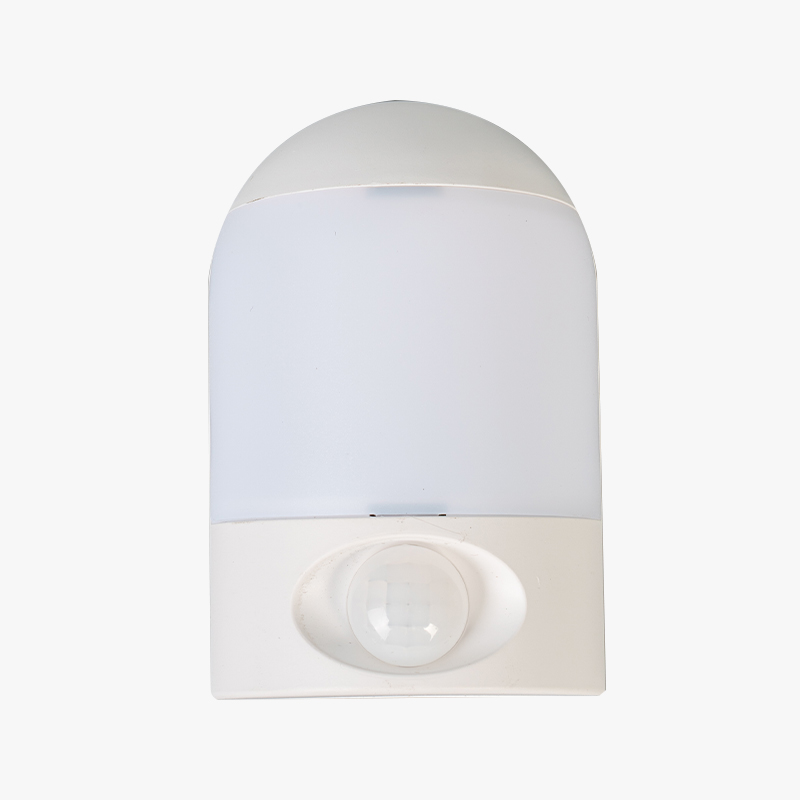
Night light brightness is measured in lumens (lm). More is not better — a night light that is too bright defeats its purpose by disrupting sleep, causing glare, and eliminating the eye's dark adaptation. The right brightness level depends on the room size and what the light needs to enable.
| Use Case | Recommended Brightness | Why |
|---|---|---|
| Child's bedroom / nursery (continuous) | 2–8 lm | Just enough to see shapes; avoids melatonin suppression |
| Adult bedroom or bedside | 5–15 lm | Enough for safe movement without waking partner |
| Hallway / corridor orientation | 10–25 lm | Sufficient to navigate safely without full ceiling light |
| Staircase safety lighting | 20–50 lm | Step edges must be clearly visible to prevent falls |
| Bathroom nighttime visit | 15–30 lm | Safe navigation and use without activating full bathroom light |
| Outdoor path / garden steps | 50–150 lm | Outdoor ambient light absorption requires higher output |
If the product specifies wattage rather than lumens, a general conversion for LED night lights is 1W ≈ 80–100 lm. A 0.1–0.2W LED night light (8–20 lm) covers most indoor orientation needs.
Light color — measured in Kelvin (K) color temperature — has a direct physiological effect on sleep quality because different wavelengths of light suppress the body's melatonin production to different degrees. This is not a minor consideration: the wrong light color can disrupt sleep quality even at low brightness levels.
The power source determines where the night light can be placed and how much ongoing maintenance it requires. Each power type has a distinct set of advantages and trade-offs.
Plug directly into a wall socket and consume 0.1–0.5W continuously — costing approximately €0.50–€2.00 per year in electricity at typical European tariffs. Zero battery replacement, zero charging, and reliable indefinite operation make plug-in models the most convenient choice for fixed locations with nearby outlets: hallways, staircase landings, bathroom outlets, and bedroom sockets. The limitation is that placement is fixed by socket location.
Battery models offer complete placement flexibility — under stairs, inside wardrobes, in corridor sections without sockets, or in any location where running a cable would be impractical. PIR-activated battery night lights are highly efficient: at 5–10 activations per night of 30 seconds each, a set of 3× AA batteries can last 6–18 months depending on the LED wattage. Continuously on photosensor models drain batteries far faster — typically 1–3 months per charge — making them unsuitable for battery operation in most cases.
Rechargeable models with a built-in lithium battery combine placement flexibility with lower ongoing cost than disposable batteries. A full charge typically provides 30–100 hours of PIR-activated runtime, and recharging via USB takes 1–3 hours. The trade-off is the need to remember to recharge before the battery is depleted — a model with a low-battery warning indicator is strongly recommended to avoid the light failing unexpectedly in the middle of the night.
For PIR-equipped night lights, the sensor's detection geometry must be matched to the physical space where it will be used. A sensor with too wide a detection angle may trigger from movement in an adjacent room through a doorway; too narrow an angle may miss movement at the room's edges.
The IP (Ingress Protection) rating indicates the night light's resistance to water and dust — a critical safety specification for bathroom and outdoor applications that is often overlooked.
| Location | Sensor Type | Brightness | Color Temp | Power | IP Rating |
|---|---|---|---|---|---|
| Child's bedroom | Photosensor (dusk-to-dawn) | 2–8 lm | 2700K or amber | Plug-in | IP20 |
| Hallway / landing | Dual (PIR + photosensor) | 10–25 lm | 2700–3000K | Plug-in or battery | IP20 |
| Staircase | Dual (PIR + photosensor) | 20–50 lm | 2700–3000K | Plug-in or rechargeable | IP20 |
| Bathroom | PIR or dual sensor | 15–30 lm | 2700K warm white | Plug-in (shaver socket) or battery | IP44 minimum |
| Adult bedroom | PIR (motion-only) or photosensor | 5–15 lm | 2700K or amber/red | Plug-in | IP20 |
| Outdoor path / steps | Dual (PIR + photosensor) | 50–150 lm | 3000–4000K | Solar or wired | IP65 minimum |
Your email address will not be published. Required fields are marked *

 Building E21, Wanyang Zhongchuang City, No. 555 Binhai Avenue, Binhai Economic Development Zone, Fenghua District, Ningbo City, Zhejiang Province
 0086-130-81920916
 [email protected]
Copyright ? Conbo Electronics Co., Ltd. All right reseved. Custom Led Lights Manufacturers Wholesale Outdoor Light Fixtures Factory